


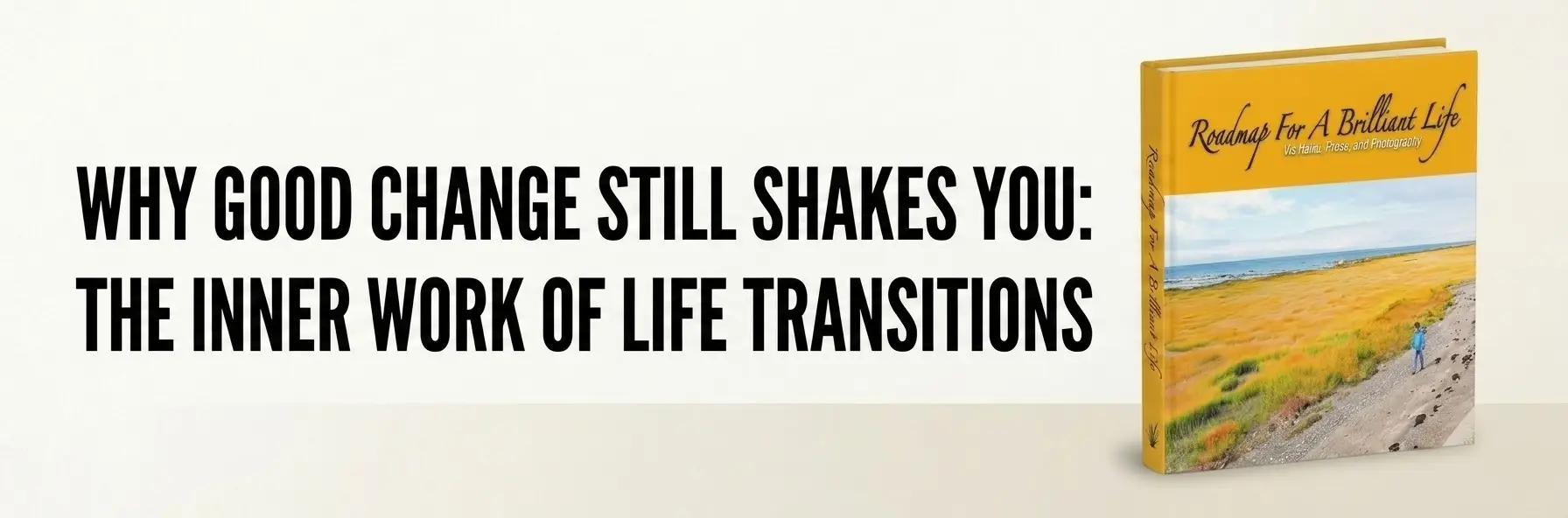
Change can be good and still feel unsettling. A promotion, a move, a marriage, retirement, a new child, a creative opportunity, or a long-awaited fresh start may be objectively positive, yet emotionally complicated. You may feel grateful and anxious at the same time. Excited and sad. Ready and strangely resistant. This tension often confuses people because they assume good change should feel easy.
But life transitions are not difficult only because something bad has happened. They are difficult because something familiar is ending. Even welcome change disrupts identity, routine, belonging, and the stories we use to understand ourselves. Roadmap For A Brilliant Life explores this truth with clarity and compassion, showing that transition is not merely an external event. It is an inner psychological process.
Understanding this process can help us stop judging ourselves for struggling. Change feels hard because the self must reorganize around a new reality. That takes time, attention, and courage.
Why Change and Transition Are Not the Same
One of the most important distinctions in understanding life transitions is the difference between change and transition. Change is external. It is the move, the diagnosis, the retirement party, the wedding, the new job, the graduation, or the empty bedroom after a child leaves home. Transition is internal. It is the emotional and psychological adjustment that follows.
This is why a change can happen quickly while the transition takes much longer. You can move into a new house in a weekend, but it may take months before it feels like home. You can retire on a Friday, but it may take a long time to understand who you are without the structure and identity of work. You can begin a new relationship and still grieve the solitude, routines, or version of yourself you left behind.
The outer world may say, “Congratulations, everything is different now.” The inner world may answer, “I need time to catch up.”
Why Even Good Change Involves Loss
Every transition includes an ending. This is true even when the new chapter is wanted. A new opportunity may end a familiar rhythm. A marriage may end complete independence. Parenthood may end spontaneity. A promotion may end the comfort of being highly competent in a previous role. Retirement may end status, structure, and daily recognition.
Because the change is positive, people often feel guilty admitting the loss. They may think, “I should be happy,” or “Other people would love this opportunity.” Gratitude is real, but it does not cancel grief. Human beings can feel more than one thing at once.
Roadmap For A Brilliant Life invites readers to honor endings rather than rush past them. This is psychologically important because unacknowledged loss does not disappear. It often returns as irritability, nostalgia, resistance, or fear. To move forward well, we must name what is ending, even when we are also thankful for what is beginning.
The Identity Shock Behind Major Transitions
Change feels hard because identity is involved. We are not only adjusting to new circumstances; we are adjusting to a new version of ourselves. A person who becomes a parent must integrate a new identity. A person who retires must discover who they are without a professional title. A person who recovers from illness may need to relate differently to the body. A person who moves away from a long-time community may wonder where belonging now lives.
Identity shock can feel like confusion. You may ask: Who am I now? What matters in this stage? What parts of me still belong, and what parts must evolve?
These questions are not signs of weakness. They are signs that transition is doing its deeper work. The self is reorganizing. Old definitions are loosening. New ones are forming, often before we have words for them.
How to Move Through Change With More Awareness
Navigating transition well does not mean avoiding discomfort. It means understanding what the discomfort is asking for. Instead of forcing yourself to be instantly confident, create room for honest adjustment.
Name What Has Changed
Be specific about what is different. Did you lose a routine, a role, a community, a sense of competence, or a familiar future? Naming the change helps the mind organize the experience and gives emotion a place to land.
Allow Mixed Feelings
You can be grateful and grieving. Excited and nervous. Hopeful and sad. Mixed feelings are normal during transition because every new beginning carries an ending. Allowing complexity prevents unnecessary shame.
Build New Rituals Slowly
Rituals help stabilize the self during change. A morning walk, quiet reflection, a regular call with a friend, journaling, prayer, or time in nature can create continuity while the rest of life is shifting. Small practices can make the new chapter feel safer.
Conclusion
Change feels hard, even when it is good, because transition is deeper than circumstance. It involves endings, identity shifts, nervous system adjustment, and the uncertain space between who we were and who we are becoming. The difficulty does not mean the change is wrong. It often means the transition is real.