


Life rarely announces its most meaningful moments in advance. They often arrive quietly, without ceremony: a breeze through an open window, a familiar voice on the phone, a warm cup held in both hands, sunlight touching the floor, a child laughing in another room, the smell of rain before it falls. These moments are easy to overlook because they seem ordinary. Yet they may be the very moments that return us to ourselves.
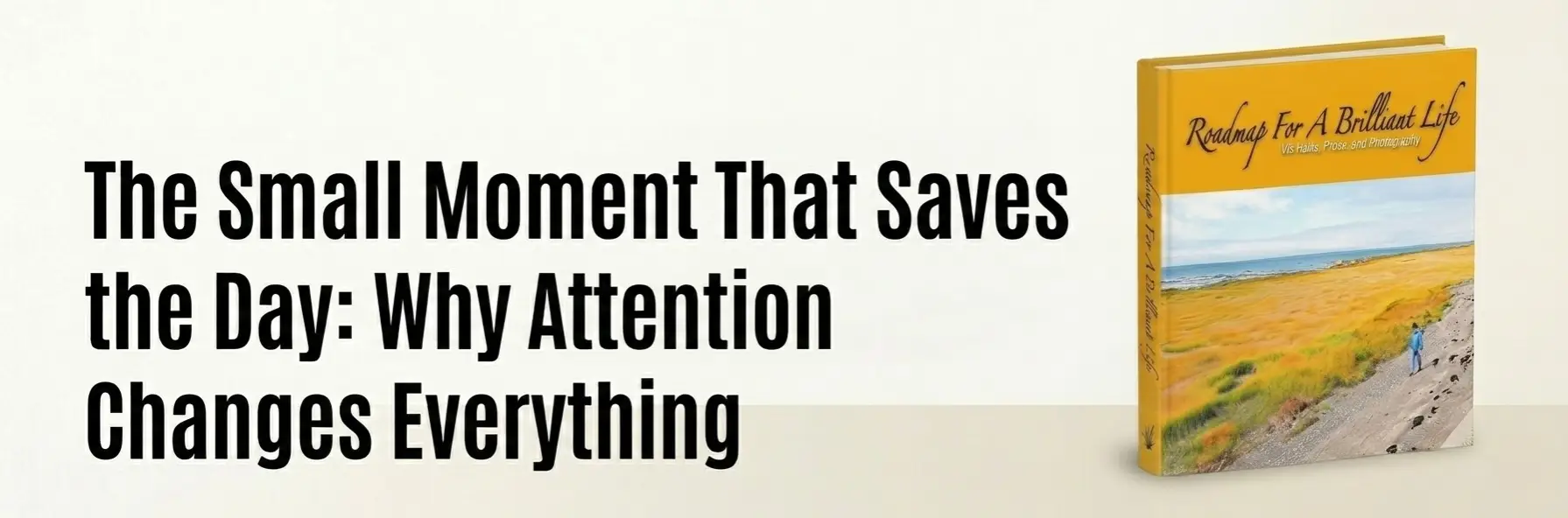
In a culture obsessed with big outcomes, small moments can appear insignificant. We are taught to measure life by milestones, achievements, transformations, and visible success. But Roadmap For A Brilliant Life offers a different kind of wisdom. It reminds us that a brilliant life is not only built through major turning points. It is also built through attention. What we notice, how we notice, and whether we allow ordinary beauty to reach us can change the way we experience everything.
Small moments do not make life perfect. But when we are present enough to receive them, they make life deeper, richer, and more bearable.
Why We Overlook the Moments That Matter
Most people do not ignore small moments because they are careless. They ignore them because modern life trains attention away from the present. There is always something urgent to answer, plan, fix, compare, or improve. The mind moves quickly from one obligation to the next, treating the present moment as a stepping stone rather than a place to inhabit.
This habit can make life feel strangely thin. Days may be full but not deeply felt. Conversations may happen without real listening. Meals may be eaten without tasting. Walks may be completed without seeing. The result is not only distraction; it is disconnection.
Attention is what turns existence into experience. Without attention, even meaningful moments pass like background noise. With attention, ordinary life becomes vivid again.
The Difference Between Looking and Seeing
There is a difference between looking at life and truly seeing it. Looking is automatic. Seeing requires presence. Looking registers objects, people, and tasks. Seeing notices texture, emotion, meaning, and beauty.
This distinction is central to the spirit of Roadmap For A Brilliant Life. The manuscript brings together haiku and photography, two forms that depend on careful attention. A photograph frames what might otherwise be missed. A haiku distills an experience into a few lines, asking the reader to pause long enough for the moment to open.
Together, these forms teach a simple but powerful lesson: the world becomes more meaningful when we learn how to see it.
Small Moments as Anchors in Difficult Seasons
Small moments matter most when life feels uncertain, painful, or overwhelming. During grief, transition, illness, aging, or emotional fatigue, the future can feel too large to hold. The mind may race toward what cannot be controlled. In those times, a small moment can become an anchor.
A breath. A hand on the shoulder. The smell of rosemary or rain. A quiet walk. A patch of sunlight. These experiences do not erase difficulty, but they bring us back into contact with life. They remind us that pain is real, but it is not the only reality.
This is not denial. It is balance. Attention to beauty does not minimize suffering. It widens the field so suffering does not occupy the whole horizon.
How Attention Changes the Nervous System
Attention is not only philosophical; it is embodied. When we slow down enough to notice something grounding, the body often responds. Breathing deepens. Muscles soften. The mind becomes less scattered. A moment of beauty, gratitude, or connection can interrupt the stress cycle and create a small opening for calm.
This is why presence can feel so restorative. The body lives in the present, even when the mind is trapped in memory or worry. When we bring attention back to sensation—the warmth of a cup, the rhythm of walking, the feel of air on skin—we return to the only place where steadiness is possible.
Notice Through the Senses
One practical way to return to attention is through the senses. What do you see, hear, smell, taste, or feel right now? Sensory awareness is simple, but it is powerful because it interrupts mental noise. It brings the mind back into the body and the body back into the moment.
Let One Detail Be Enough
You do not have to notice everything. Begin with one detail. One color. One sound. One breath. One expression on someone’s face. Attention grows through small repetitions.
Conclusion
The power of small moments lies in their ability to bring us back. Back to the body. Back to beauty. Back to connection. Back to the truth that life is not only made of milestones, but of countless ordinary experiences asking to be received.
Roadmap For A Brilliant Life reminds us that attention changes everything because it changes our relationship to what is already here. A path becomes more than a path. Rain becomes more than weather. A conversation becomes more than an exchange of words. A breath becomes a place to begin again.
If life feels rushed, flat, or overwhelming, do not wait for a grand transformation before returning to it. Start small. Notice one thing. Let it reach you. Let it remind you that you are here.
Sometimes the moment that saves the day is not dramatic at all. It is simply the one you finally allow yourself to see.